
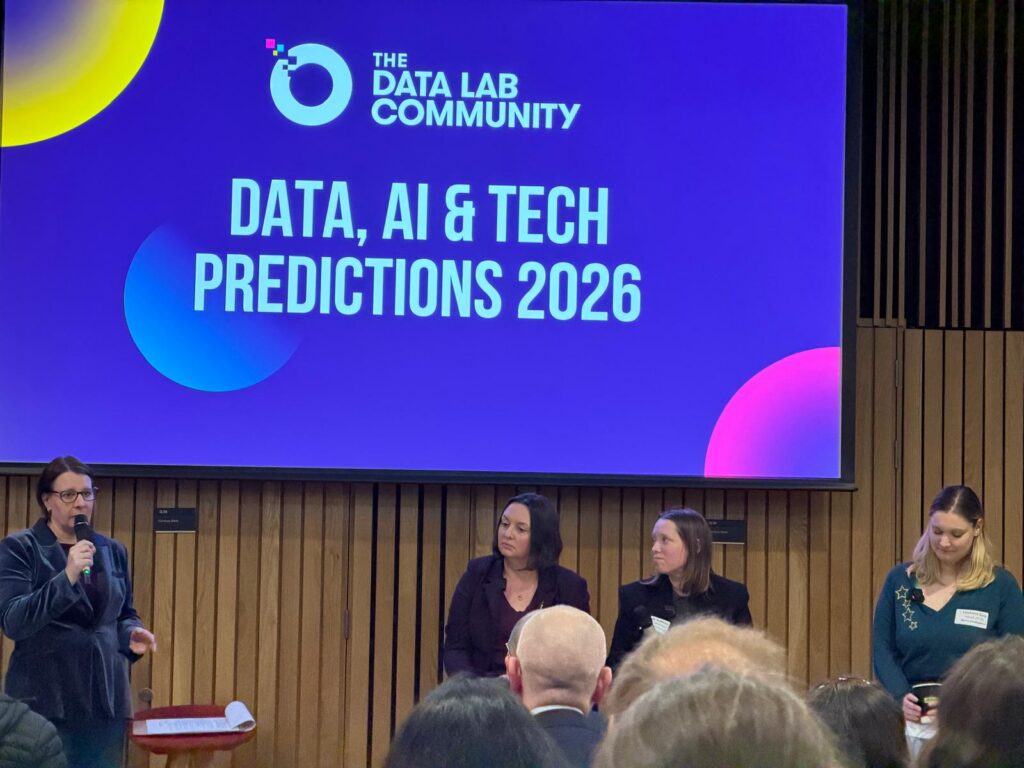
I recently had the opportunity to attend The Data Lab’s “Data, AI and Tech Predictions 2026” event. It was a refreshing deep dive that moved past the usual buzzwords and into the gritty reality of what the next year actually holds for the industry.
The session was chaired by Heather Thomson (CEO, The Data Lab), who guided a sharp discussion with an exceptional panel: Stephanie Earp (Head of AI, Space Intelligence), Nic Granger OBE (Chair of the Governance Board, The Data Lab), and Emily Sullivan (Co-director, Centre for Technomoral Futures).
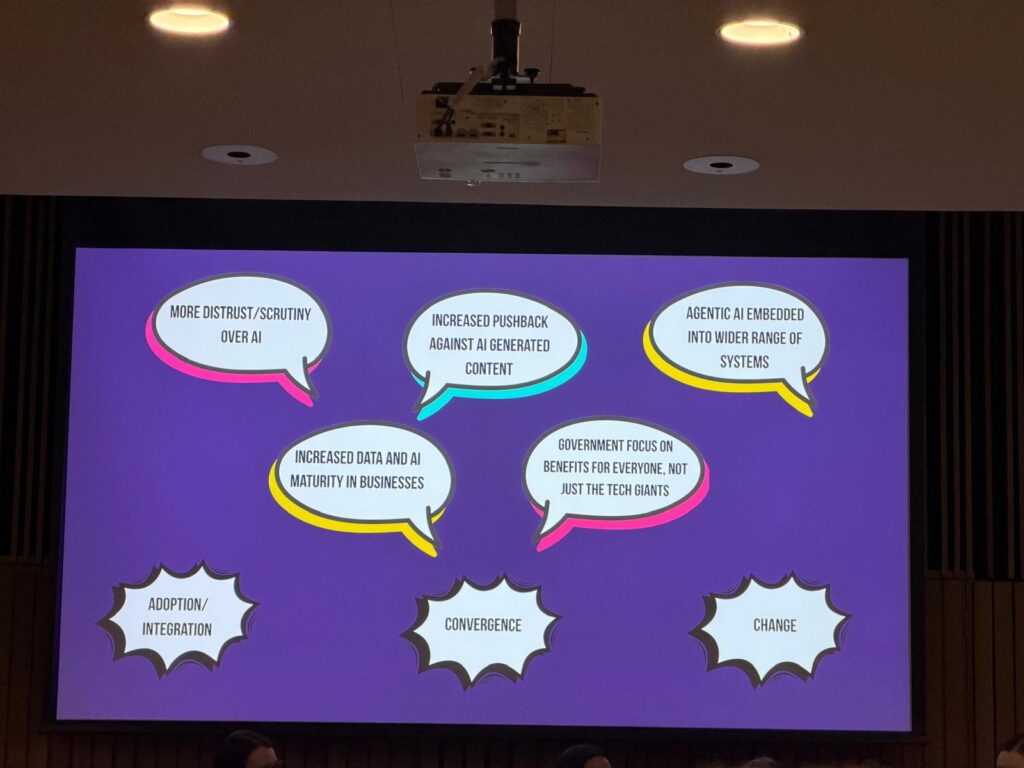
If I had to summarise the mood, it wasn’t about “what new magic will AI do?” but rather, “how do we live, work, and stay safe with what we’ve built?”
Here are my key takeaways from the discussion.
1. The “Boring” Stuff Still Matters Most
One of the strongest themes, particularly championed by Nic Granger, was a return to fundamentals. There is a tangible risk for companies trying to push an “AI Agenda” without having their data house in order first.
We are seeing a move toward Data Sovereignty. There is growing concern regarding reliance on US-based cloud services and tech giants. The panel highlighted the risk of “grabbing off-the-shelf AI”—by doing so, are you handing over your proprietary insights to another company? To maintain a competitive advantage, businesses must integrate agents into their workflows while maintaining strict control over their own data.
2. The Shift from LLMs to SLMs (Small Language Models)
Is the AI bubble about to burst? The panel thinks not, but it is changing shape.
Stephanie Earp made a compelling point: if people are talking about a “burst,” it’s actually a sign of maturity. It means we are realising where AI is not appropriate. The future isn’t just massive Large Language Models (LLMs) that burn through energy; it’s about sustainability and Small Language Models (SLMs).
Stephanie used the example of satellite technology. You cannot run a massive model in orbit; you need energy efficiency and specific utility. The industry is moving toward making the smallest models possible to embed into products, solving specific problems rather than just asking “what can I do with AI?”
3. The Money is Moving: From Climate to Defence
A sobering insight from Stephanie was on the flow of capital. Previously, we saw a massive influx of investment into Climate Tech and Health Tech. However, in the current geopolitical climate, the priority—and the money—is shifting toward Defence and Security. We need to be mindful of which sectors might lose momentum as security takes centre stage.
4. The Human Element: Ethics, Literacy, and the Divide
Emily Sullivan brought the conversation back to the societal impact. We aren’t just dealing with code; we are dealing with people’s likenesses, deepfakes, and the safety of children (referencing the debate on social media bans for under-16s).
A major challenge identified was the Digital Divide. As noted in the discussion, perhaps only 5% of users are “power users,” while 95% use AI tools much like they use Google—surface level and unoptimized.
The solution?
- Education: It’s not just teaching kids how to use AI, but teaching them how not to use it.
- Practical Application: Nic highlighted how tech is making a real difference in social housing, using sensors for mould detection and predictive analytics to help the vulnerable.
5. Regulation is a Global Challenge
Regulation was the elephant in the room. Because AI is global, regulating it locally is incredibly difficult. The panel touched on the “Tech-Power Grab”—the tension between corporate capability and government guardrails.
As we look toward 2026, the challenge will be creating guardrails that prevent data leakage and protect digital identity without stifling the innovation that, as Stephanie noted, gives us “a lot of hope.”
Final Thoughts
When asked for a single word to describe the AI trend for the coming year, the panellists chose:
- Resilience
- Tech-power grab
- Accountability
These three words perfectly encapsulate the crossroads we are at. 2026 won’t just be about better chatbots; it will be about building resilient infrastructure, watching where the power (and money) flows, and holding the technology- and ourselves-accountable for how it is used.