
At this year’s Oxford Energy Day, the central theme was resilience—and what struck me most was how they never shy away from speaking their mind. Whatever the topic, they have the confidence to put the harsh realities right out on the table.
With our increasing reliance on electricity, one of the major questions discussed was: how prepared are we for a power cut?
Major European countries are currently preparing for how to survive up to three days without power. This brings up incredibly gritty, practical questions—like how exactly do you manage sewage systems when the grid goes down for that long? (Spoiler: the Europeans might have figured it out, but we haven’t asked them that question yet).
During the event, Jim Watson from UCL shared a quote on his slide from Winston Churchill in 1913 that still holds true today:
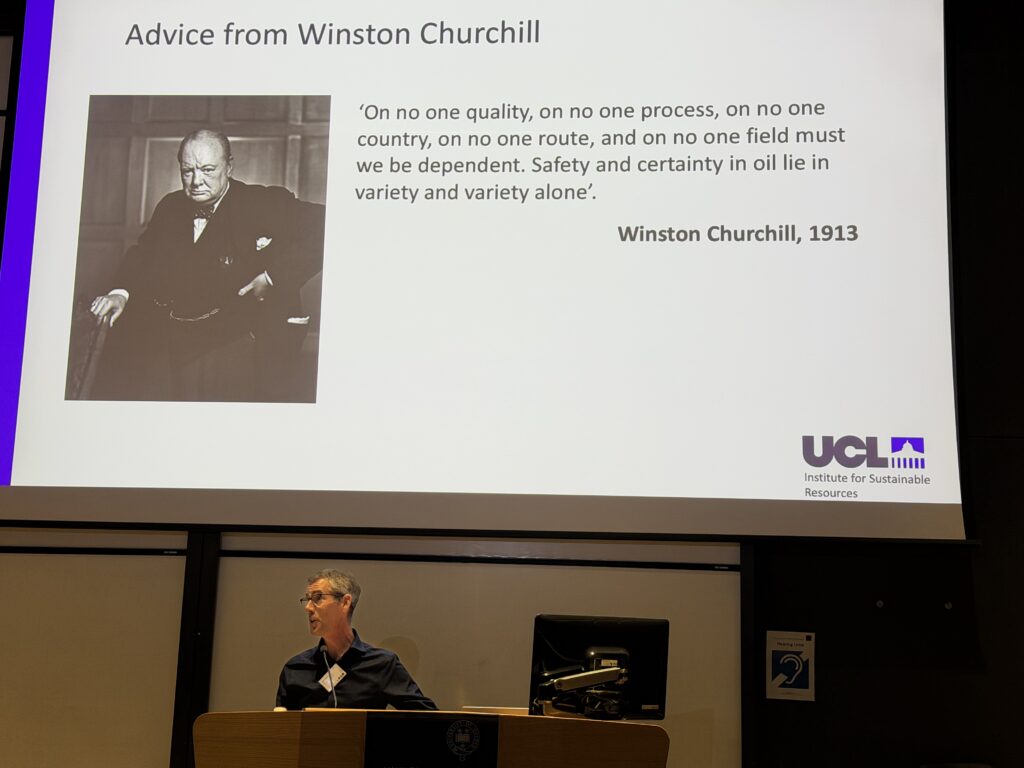
While Churchill was talking about energy, this need for variety holds true in all aspects of life, especially when it comes to the people in a company.
True resilience requires a variety of thought, gender, and racial diversity. Without it, you just build an echo chamber. But pointing out a lack of diversity often makes people defensive. The immediate pushback is usually a variation of, “We aren’t doing a box-ticking exercise; people are here on their own merit.”
A mentor recently shared a harsh truth with me about this. When hiring or building teams, people subconsciously ask themselves: If I am stuck in an airport with someone for hours, who would I want that to be?
Unsurprisingly, they choose the people with similar interests and similar profiles. It sucks, but that seems to be the reality. People gravitate toward similarity because it is easy. It is comfortable.
I have been reflecting on this lately in the context of my own work at PNDC. Almost five years ago, I started hosting fortnightly “Knowledge Exchange” sessions. I brought the concept with me from the University of Oxford, adapting Malcolm McCulloch’s “reading group” into something suited for our industry-facing environment.
I didn’t start it with the grand intention of fighting the “airport test”, I just wanted a space to share ideas. But this week, I unexpectedly received an award from the University, and the nomination highlighted how this exact session breaks down echo chambers.
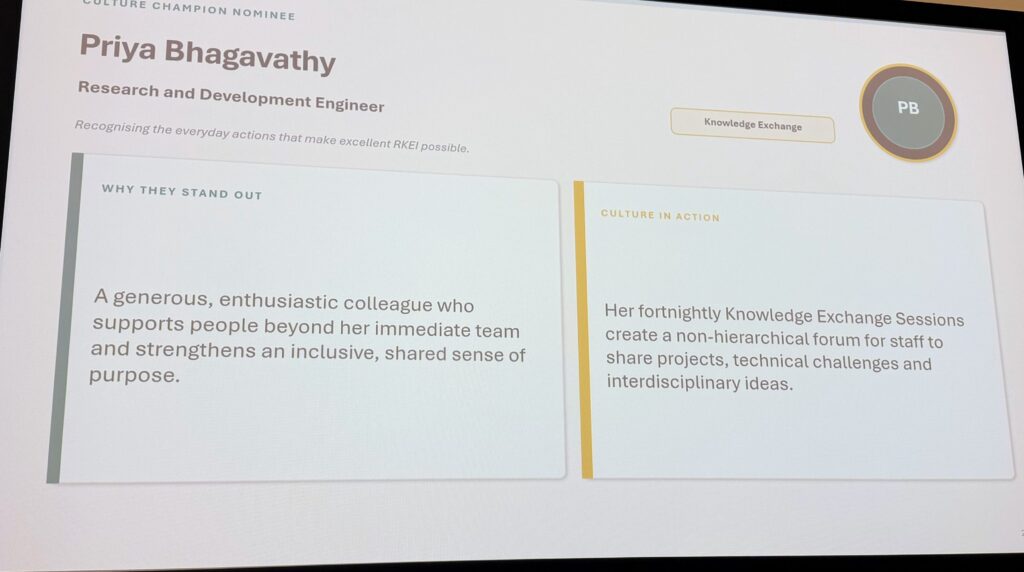
The slide at the award presentation noted that the sessions “create a non-hierarchical forum for staff to share projects, technical challenges and interdisciplinary ideas.” The broader nomination stated it is the only recurring event in our department not directly aligned to organizational hierarchy, promoting interdisciplinarity, inclusion, and engagement.
Creating these spaces, intentionally bringing variety into the room and stepping outside our immediate silos, creates natural friction. But as I learned from the second half of Oliver Burkeman’s Four Thousand Weeks, seeking only what is comfortable is a terrible strategy for navigating reality.
Burkeman illustrates this with the story of a monk going through initiation. The monk had to take baths in a freezing mountain stream, wiping himself with a towel so frozen it felt like rubbing himself with ice. For the first few days, the monk tried to think about anything but the freezing bath. It seems like common sense to distract yourself from the pain.
But it was exactly the wrong strategy. The more he concentrated directly on the sensation of extreme cold, the less agonising he found it.
The real problem wasn’t the cold water; it was his internal resistance to it.
When we build echo chambers and hire only the people who pass our “airport test,” we are just trying to avoid the freezing water. We try to avoid the natural friction of dealing with people who think differently, look different, or challenge our assumptions.
We try to dictate the course of events to make our lives perfectly smooth. But as Churchill pointed out, safety actually lies in variety. You can’t avoid tough choices, you can’t make the world run exclusively at your speed, and you can’t guarantee that working with other humans will be frictionless.
If we can accept the unpleasantness of our limited control and stop fighting the cold water, we might build systems, and lives, that are truly resilient.
Next week in the final part of this series: The 5 questions we all need to ask ourselves, and my attempt at the 3-hour museum challenge.