

There is nothing quite like a room full of “energy nerds” to get the blood pumping on a cold January morning.
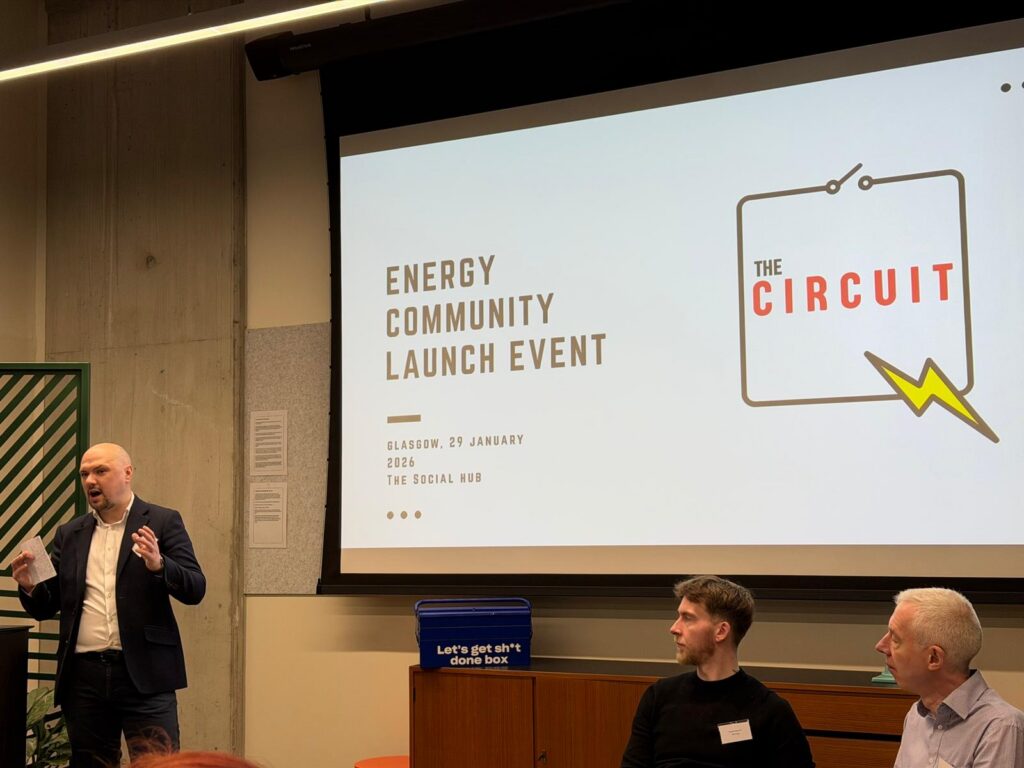
On January 29th, I attended the inaugural Circuit Energy Community Breakfast Briefing. The goal? Bringing together a multidisciplinary mix of SMEs, academics, and policymakers to tackle the gargantuan challenge of decarbonisation. It was a fantastic launch, with plenty of time for the kind of networking that actually moves the needle.
But as the coffee was poured, the data started to flow—and it was a wake-up call.

The Technical Reality Check: Adequacy vs. Security
Professor Keith Bell (University of Strathclyde) kicked things off with a “Beginners’ Guide to Energy Supply Resilience.” He drew a crucial distinction that often gets blurred in policy papers:
- Adequacy: The “slow-burn” threats. Think fuel extraction disruptions, supply chain hiccups, or long-term adverse weather.
- Security: The “fast-burn” threats. Sudden asset failures, comms breakdowns, or human error.
The Storage “Math” Problem
Keith’s slides on residual energy requirements to ‘meet the peak’ were particularly eye-opening. If we look at historical weather events (like the 2006 peaks) and project them onto our future system, the numbers for required storage are staggering:
- 1 Day of Peak Demand: ~1 TWh
- 1 Week of Peak Demand: 5.9 TWh
- 4 Weeks of Peak Demand: 14.5 TWh
To put that in perspective, our current UK Gas Storage capability is about 10 TWh. However, under the Clean Power 2030 (CP30) estimates, non-fossil storage is pegged at just 0.13 TWh.
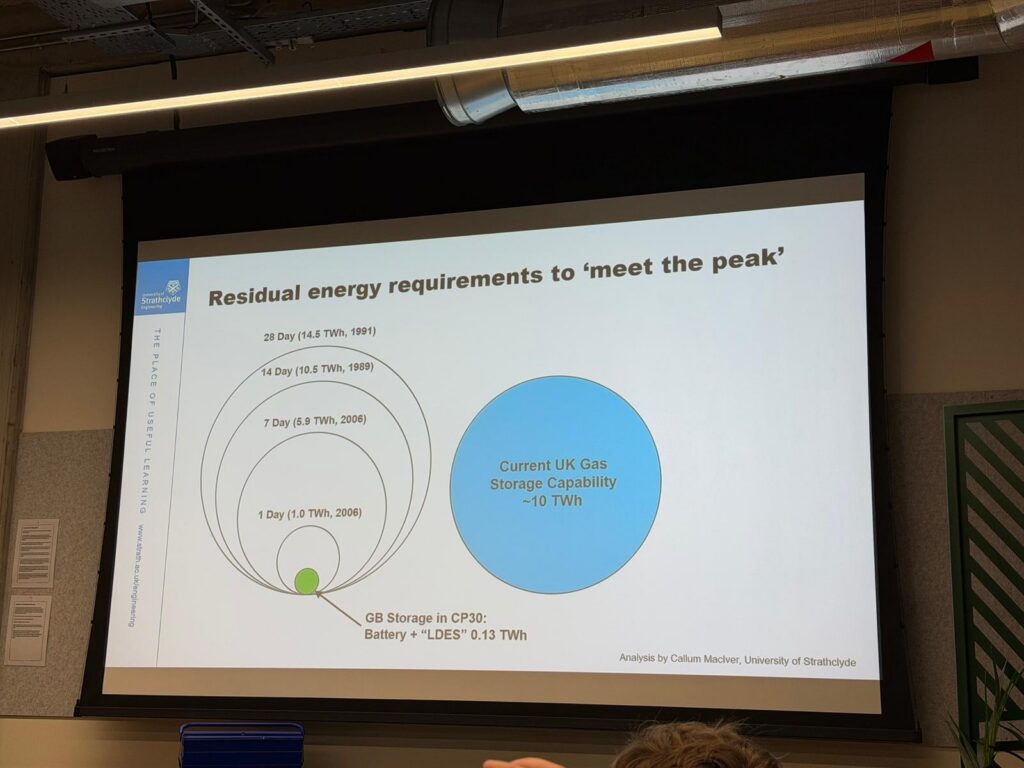
The question we have to ask: Have we missed something in CP30? Are the assumptions incoherent, or are we vastly underestimating the “energy gap” during extreme weather events?
A View from PNDC: The Local Transformer Crisis
At PNDC, our analysis of 1-in-20 extreme weather events adds another layer of complexity: the local level. When the temperature drops, heat pumps (HPs) don’t just run; they run at full capacity.
- With 20% HP penetration on the network: We see 20% transformer overloading.
- With 50% HP penetration: Transformers overload by 60%, pushing hotspot temperatures to 150°C.
This isn’t just a technical glitch; it’s a recipe for significantly reduced asset life and potential failure. The mismatch isn’t just national; it’s happening on your street corner.
How Quickly Can We Flip the Switch?
One of the most jarring moments of the morning was comparing UK restoration standards to our European neighbours.
| Event/Standard | Region | Time to 100% Restoration |
| Spain/Portugal (April 2025) | Europe | < 12–16 Hours |
| Italy (Sept 2003) | Europe | ~18 Hours |
| UK Standard (Effective Jan 2027) | Great Britain | 5 Days |
We are aiming for 60% restoration in 24 hours, but a full recovery could take nearly a week. In a world where we are asking everyone to switch to EVs and electric heating, a 5-day outage isn’t just an inconvenience—it’s a systemic failure. This “interruption anxiety” is a massive, often overlooked barrier to the EV transition.
The Social & Political Pillar
Following Keith’s data-heavy session was a tall order, but Fraser Stewart (GB Energy) brought it home by focusing on social resilience.
His message was clear: Bills matter. While we know long-term costs should be lower in a decarbonised system, we have to be honest about the “middle bit.” Who foots the bill now, and how is that cost distributed?
Fraser’s Key Takeaways:
- A Just Transition: This isn’t a “nice-to-have”; it is the foundation of political resilience.
- Local Ownership: People accept renewables much more readily when they own them, rather than when a developer drops them in.
- Honesty: We need an honest conversation about the costs and the timeline.
Final Thoughts
The Circuit Energy launch was a reminder that while the “Idea” of decarbonisation is great, the “Engineering” and “Equity” of it are incredibly hard. We have a lot of work to do to bridge the gap between 0.13 TWh of planned storage and the 14.5 TWh we might actually need when the North Wind blows.
Let’s keep the conversation—and the coffee—flowing.