

It has been a full month since I published Part 2 of this series. Between being completely swamped at work and sharing updates about my startup, life simply got in the way. Honestly, delaying a blog post about time management because I ran out of time feels entirely on-brand for Oliver Burkeman’s Four Thousand Weeks.
To wrap up my reflections on the book, I decided to attempt the “homework” Burkeman assigns to confront our discomfort with the present moment: go to a local museum, pick a single work of art, and just watch it for three hours. No checking emails. No coffee breaks.
Knowing the current state of my brain, I knew three hours was an absolute impossibility. So, I scaled it down to a one-hour experiment. I visited the Stirling Smith Art Gallery & Museum and chose The Summer Garden, an 1895 oil on canvas by John Lochhead.

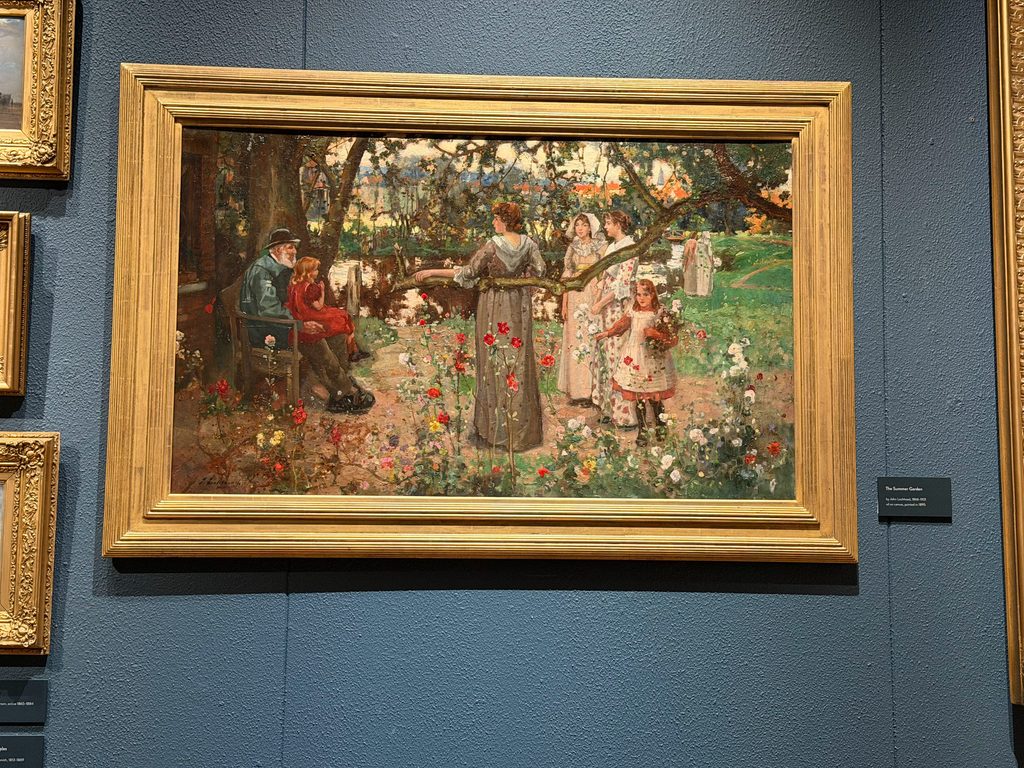
How did I do? I lasted roughly 30 minutes before giving up. The painting was lovely, but I quickly ran out of details to stay grounded on, and an overwhelming wave of sleepiness hit me.
I did walk away with one unexpected observation, though. Looking closely at the figures in the painting, I noticed that all the adults had a distinct bend in their necks—the exact posture doctors today blame on mobile phone usage. It made me wonder if having a straight neck is actually a relatively modern requirement!
Aside from 19th-century posture, those 30 minutes proved Burkeman’s point. We struggle to simply sit in the present because we are trapped in the “When I finally…” mindset. When I finally get my workload under control… when I finally launch this next phase… then I can relax. We treat the present solely as a tool for the future, convincing ourselves that once we tick off enough boxes, we will finally feel in charge of our lives.
But salvation is never coming. The productivity standards we set for ourselves were never reachable in the first place.
When the weight of everything we haven’t done feels like too much, Burkeman prescribes Cosmic Insignificance Therapy. The premise is blunt: the universe doesn’t give a flying f*** about you.
When you zoom out far enough, your life, and all its daily pressures, is indistinguishable from nothing at all. Far from being bleak, this is a massive relief. Status rivalries, money worries, endless to-do lists, and even pandemics and presidencies shrink instantly down to irrelevance. The cosmos carries on regardless, calm and imperturbable.
Before closing the book, I distilled five confronting questions Oliver Burkeman poses to help us let go of impossible standards. Put into my own words, they are worth sitting with (even if you can only manage 30 minutes):
- Where are you choosing the easy, comfortable route in your work or personal life when you know deep down you need to lean into the discomfort?
- Are you beating yourself up against productivity standards nobody could ever actually hit? If you truly accepted that you are never going to “get on top of everything,” what would you do differently today?
- Where are you still fighting against who you actually are in favour of some idealised version of who you think you “should” be—and honestly, how do you actually enjoy spending your time?
- What are you putting off right now just because you’re waiting until you feel like you fully know what you’re doing?
- How would your days change if you stopped obsessing over seeing guaranteed results or immediate outcomes from everything you do?
Drop the impossible list of things. Pick a few from the rubble that matter the most, and just do the next right thing.
The book also includes a great appendix of 10 practical ways to embrace our finitude. I won’t plagiarise the author by listing them all here, but I took detailed notes. If anyone wants to discuss them or swap thoughts on the book, reach out—I’d love to chat.
Missed the earlier posts in this series? Catch up on Part 1 and Part 2 here.